
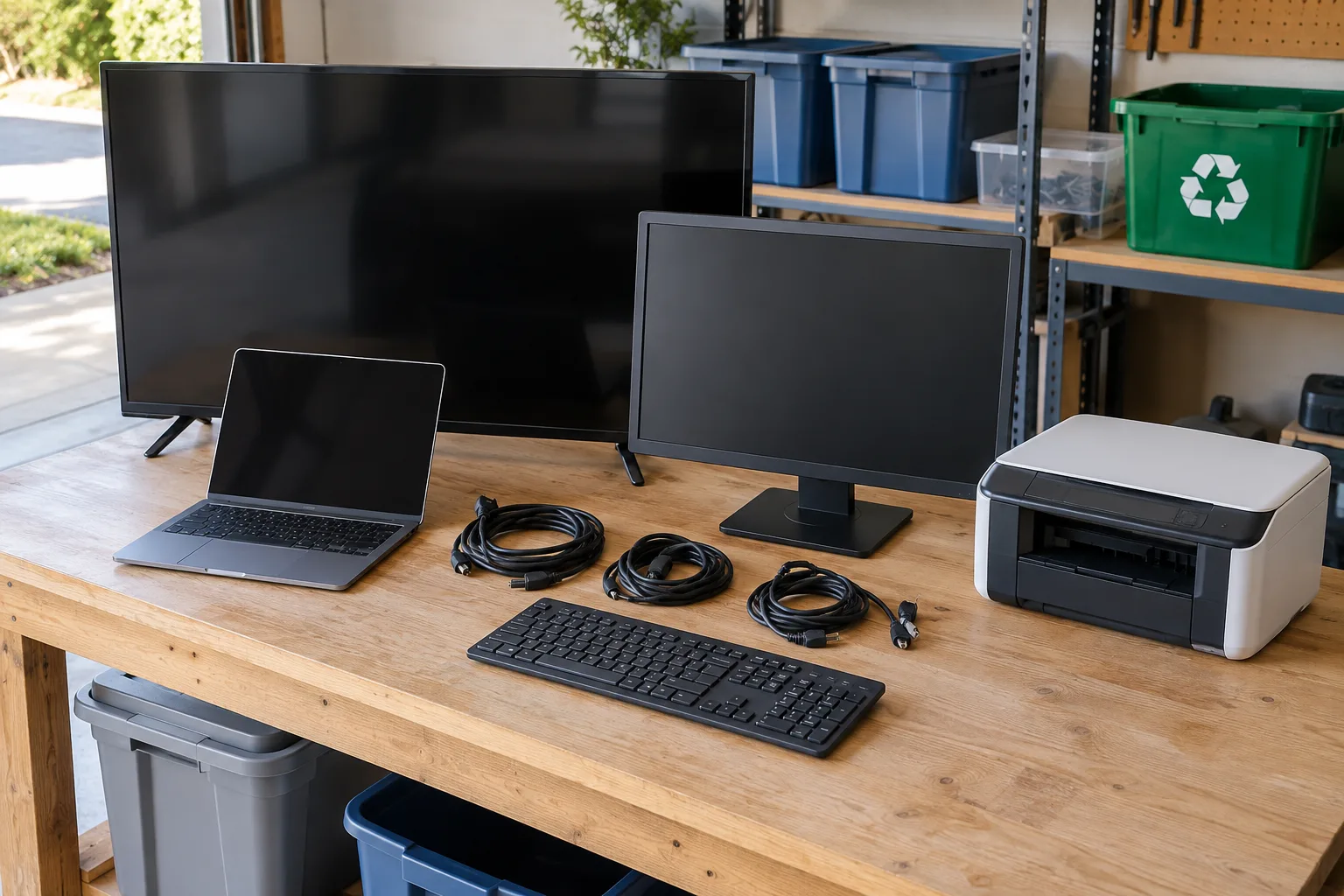
Back up what you need, sign out of accounts, erase personal data with the manufacturer’s reset instructions, and separate loose batteries before electronics leave your control. Then choose a collection route that actually accepts the device and its battery type.
This guide covers households in Los Angeles County, with City of Los Angeles resources called out separately. Program rules and event schedules change, so verify the destination before driving there.
Handle the data first
A recycler can process hardware without being responsible for your files. Copy needed photos and documents, remove memory cards and SIM cards, sign out of services, and use the device maker’s supported erase or factory-reset process. For an employer-owned device, follow the company’s IT process instead of wiping it yourself.
Treat batteries as a separate question
Rechargeable devices may contain batteries that can spark when compacted. LA Sanitation tells residents to recycle them properly rather than placing them in regular trash. Do not puncture, crush, open, or tape over a swollen device to force it into a box. Ask the receiving program how it wants loose, damaged, or embedded batteries handled.
Choose the right collection route
| Device or condition | Preparation | Route to verify |
|---|---|---|
| Working phone, laptop, or tablet | Back up, sign out, erase, remove SIM or memory card | Reuse, manufacturer take-back, or verified electronics recycler |
| TV, monitor, printer, or desktop computer | Remove personal media and accessories you want to keep | LASAN bulky pickup or S.A.F.E. Center, depending on current rules and address |
| Loose rechargeable batteries | Keep terminals from contacting metal; follow program packaging instructions | Battery or household hazardous-waste collection |
| Swollen, leaking, burned, or damaged battery/device | Do not handle beyond what is needed for immediate safety | Call the local hazardous-waste authority for direction before transport |
| Business electronics | Inventory assets and follow data-destruction policy | Verify business eligibility; household programs may not accept commercial quantities |
LA Sanitation says City and County residents can use S.A.F.E. Centers and other collection programs for household hazardous waste, while eligible businesses must make an appointment. Its guidance also says to transport household hazardous waste in sturdy, leak-proof, labeled containers secured in the trunk or cargo area. Review the official S.A.F.E. Center guidance. Source checked September 23, 2026; City and County eligibility varies by program.
The Los Angeles County Sanitation Districts also publishes collection events and states that its household program provides a legal, no-cost route for unwanted household chemicals and electronics. Check the County program page for current dates and limits. Source checked September 23, 2026; Los Angeles County households.
A five-minute handoff checklist
- Needed files are backed up and readable.
- Accounts are signed out and device locks removed when appropriate.
- Personal data is erased using supported instructions.
- SIM cards, memory cards, and accessories you want are removed.
- Loose batteries are separated and the destination has confirmed acceptance.
If you need help moving larger electronics after the data is handled, see electronics removal and recycling preparation. For a small load that fits an official program, the public route may be the better choice.